2026-10-12 · Friday Report Team
Quick Summary
● Identify hidden overallocation early. Individual project plans often look perfectly healthy in isolation while collectively demanding impossible effort from shared teams. Consolidating these views prevents late-stage delivery failures.
● Distinguish availability from capacity. Having hours on a calendar does not mean those hours are usable for project work. Operational duties, meetings, and support tasks consume significant portions of the workweek.
● Protect shared specialists. Solution architects, security experts, and data engineers frequently become portfolio bottlenecks. Their time must be managed across all initiatives simultaneously to maintain workflow.
● Shift to portfolio-level visibility. Moving away from siloed project tracking allows leadership to see structural capacity gaps. This enables proactive hiring or reprioritization before schedules break.
● Connect your planning data. Linking projects, people, and schedules provides a realistic picture of upcoming demand. This connected approach ensures staffing decisions reflect true organizational capacity.
Introduction
Every project plan looks reasonable until they are placed beside each other. Resource overload is often difficult to see when staffing decisions are made one project at a time. A schedule that appears perfectly balanced to a single project manager can contribute to a massive structural deficit for the organization.
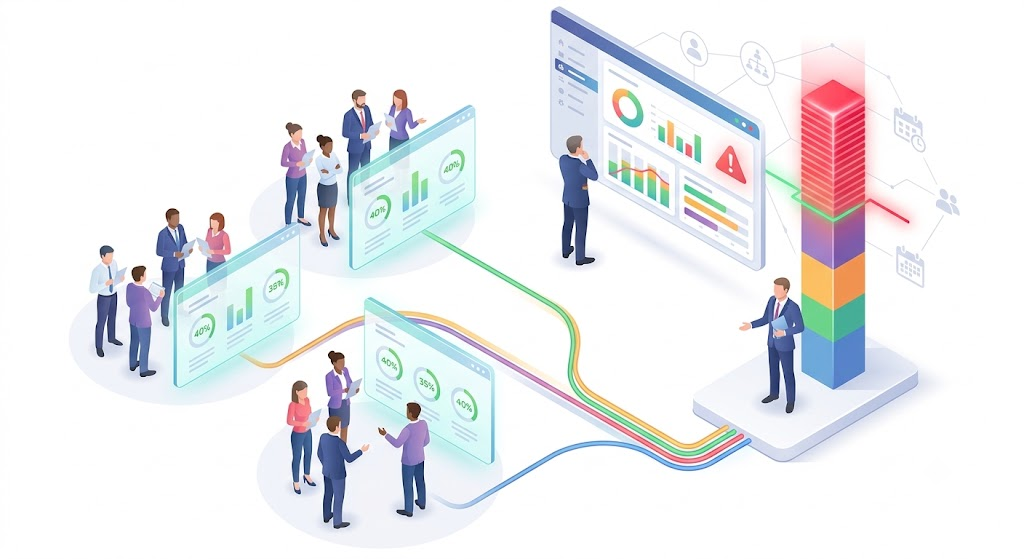
Consider a concrete example involving a shared specialist named Sarah. She is allocated 40% to Project A, 35% to Project B, and 40% to Project C. Each project manager sees what appears to be a reasonable, partial commitment that leaves plenty of room for other work.
The portfolio, however, sees a 115% commitment for a single person. This mathematical impossibility remains hidden until Sarah inevitably misses a milestone, at which point the organization treats a systemic planning failure as an individual performance issue.
project resource overallocation | resource overload / hidden overallocation / project bottlenecks |
project capacity planning | capacity forecasting / realistic scheduling / demand planning |
resource utilization across projects | cross-project allocation / utilization tracking / shared workload |
portfolio workload management | portfolio balancing / workload distribution / enterprise capacity |
shared project resources | shared specialists / matrix resources / cross-functional teams |
resource capacity planning | capacity modeling / resource forecasting / availability tracking |
project portfolio resource management | portfolio resourcing / strategic staffing / PMO resource planning |
resource allocation across projects | multi-project staffing / allocation visibility / resource conflicts |
Key Factors Overview
Factor | Description |
Siloed Planning | Project managers build schedules independently without seeing other commitments. |
Specialist Bottlenecks | Highly skilled individuals are requested by multiple projects simultaneously. |
Invisible Work | Operational duties and support tasks are excluded from capacity calculations. |
Optimistic Scheduling | Plans assume 100% of a person's time is available for project execution. |
Fragmented Tools | Different departments use disconnected systems to track the same people. |
Before Checklist
● Audit your current visibility. Check if you can see a person's total commitments across all active initiatives. If you have to ask three different managers to understand one person's workload, your visibility is broken.
● Identify your shared specialists. List the roles that are constantly requested by multiple project teams. These are your most likely points of failure when portfolio demand increases.
● Review allocation assumptions. Examine how project managers are estimating resource availability. Ensure they are not assuming full-time availability for people who have operational day jobs.
● Check for conflicting priorities. Look for instances where the same team is assigned to multiple "top priority" projects. Clarify which initiative takes precedence when conflicts inevitably arise.
After Checklist
● Establish a single source of truth. Ensure all project resource requests flow through a unified portfolio view. This prevents shadow allocations and surprise commitments.
● Define realistic capacity baselines. Standardize how much time people actually have available for project work. Deduct standard hours for meetings, administration, and operational support.
● Monitor cross-project utilization. Regularly review aggregated workload reports for shared teams. Intervene when individuals consistently exceed healthy allocation thresholds.
● Align staffing with strategy. Use portfolio data to ensure your most critical projects have guaranteed access to required skills. Deprioritize lower-value work to free up capacity for strategic initiatives.
Table of Contents
Section 1: Why overallocation hides inside otherwise healthy project plans
Project resource overallocation rarely stems from malicious intent or deliberate overwork. It typically occurs because projects are managed separately by leaders who only have visibility into their own immediate needs. When different planning tools are used across departments, there is no central mechanism to catch conflicting commitments.
This problem is compounded by inconsistent allocation assumptions across the organization. One project manager might assume a shared specialist has 20 hours available, while another assumes the same person has 30 hours. Furthermore, informal work and quick favors are rarely represented in official project plans, consuming capacity invisibly.
As noted in industry discussions on [Shared resources: how to manage them across projects](https://www.teamwork.com/blog/shared-resources), parallel planning without shared visibility is a root cause of failure. Project managers naturally plan around local needs rather than enterprise capacity. Without a consolidated view, the organization continues to approve new work until the system breaks.
Section 2: Availability is not the same as capacity
A common trap in project capacity planning is equating a 40-hour workweek with 40 hours of project availability. Someone having hours on paper does not necessarily mean those hours are realistically usable for new initiatives. True capacity must account for the friction of daily organizational life.
Capacity is heavily affected by operational responsibilities, recurring meetings, and routine support work. Management duties, mentoring, and administrative tasks also consume a predictable percentage of every week. When planners ignore these realities, they build schedules based on a fantasy version of the workday.
Furthermore, leave, holidays, and existing delivery commitments must be factored into any realistic capacity model. Failing to account for these elements guarantees that projects will run behind schedule. Accurate planning requires acknowledging that a person's usable project time is always a fraction of their total employment hours.
Section 3: The shared-resource problem
The most severe resource allocation across projects usually involves people or teams required across several initiatives simultaneously. Solution architects, security specialists, and data engineers are classic examples of shared resources. Legal reviewers, subject-matter experts, and executive sponsors also fall into this category.
These individuals can become hidden portfolio bottlenecks even when the overall organization appears well staffed. Because their specific skills are scarce, they are sliced into tiny allocation percentages across dozens of projects. This constant context switching destroys their ability to focus and deliver meaningful progress.
When a shared specialist falls behind, every project they touch is delayed. The organization might have hundreds of available developers, but if the single security reviewer is overloaded, nothing deploys. Managing these shared resources requires a portfolio-level perspective to protect them from conflicting demands.
Section 4: Why overload often shows up as a project problem later
Resource overload rarely announces itself immediately upon project kickoff. Instead, it manifests as downstream effects that look like standard project execution failures. Missed milestones and slipping task handoffs are often the first visible symptoms of a capacity crisis.
As the pressure mounts, work is repeatedly reprioritized, causing confusion and inefficiency. Specialist reviews become severe bottlenecks, forcing teams to wait idly for approvals. In some cases, teams begin working around unavailable contributors, leading to compromised quality and technical debt.
It is important to note that not all project delays are resource-allocation problems. However, when multiple unrelated projects begin missing deadlines simultaneously, the root cause is often a shared capacity deficit. Recognizing these symptoms early allows leadership to address the structural issue rather than blaming individual project teams.
Section 5: Why portfolio-level visibility changes the conversation
There is a profound difference between seeing "Project A has the people it needs" and seeing "The same five people are carrying critical work across six initiatives." The first statement provides false comfort based on isolated data. The second statement reveals a fragile portfolio architecture that requires immediate executive attention.
Portfolio-level visibility changes the conversation from local optimization to global feasibility. It allows leadership to identify collisions earlier, long before they impact critical path deliverables. According to insights on [Resource Management, Capacity & Portfolio Planning | BigTime Software](https://www.bigtime.net/bigtime-enterprise-psa/faq/category/resource-and-capacity-planning), overallocation serves as a vital portfolio risk signal.
When consolidated visibility is achieved, resource negotiations become data-driven rather than emotional. Leaders can clearly see the trade-offs required to staff a new initiative. This transparency prevents the organization from making promises it mathematically cannot keep.
Section 6: Better resource conversations happen before schedules break
To prevent project resource overallocation, organizations must ask better planning questions during the intake phase. Leaders need to know exactly who is shared across initiatives and where the same skills are required simultaneously. Identifying these overlaps early is the essence of effective project capacity planning.
It is also crucial to distinguish which assignments are tentative versus committed. Planners must ask which milestones depend on scarce specialists and what happens to other projects if one initiative slips. These questions reveal the hidden dependencies that connect seemingly unrelated projects.
Having these conversations before schedules break allows for proactive adjustments. Teams can sequence work differently, adjust scope, or secure external contractors before the crisis hits. Proactive resource conversations are the hallmark of a mature project portfolio management office.
Section 7: How connected portfolio information helps
Solving the portfolio workload management puzzle requires connecting disparate pieces of organizational data. This is where FridayReport provides significant value to PMO leaders and operations heads. The goal is not simply displaying utilization, but creating a cohesive picture of organizational reality.
FridayReport connects projects, people, schedules, workload, and upcoming demand into a single, unified environment. This allows leaders to understand exactly how one staffing decision affects the wider portfolio. When a project manager requests a specialist, the system immediately shows the impact on other active initiatives.
By bringing this information together, organizations move away from guessing and hoping. They can confidently commit to delivery dates knowing the required capacity actually exists. Connected portfolio information transforms resource management from a reactive scramble into a strategic advantage.
Frequently Asked Questions
SECTION 1: Understanding the Problem
FAQ 1. Why does project resource overallocation happen?
It happens because projects are planned in isolation without a shared view of total capacity.
When multiple project managers request time from the same people using disconnected tools, the aggregate demand easily exceeds 100%. No single person sees the complete picture until the individual is already overwhelmed and missing deadlines.
Real Results: A financial services firm reduced missed deadlines by 40% simply by requiring all project managers to use a shared resource pool view.
Takeaway: Siloed planning is the primary driver of resource overallocation.
FAQ 2. How does resource capacity planning differ from scheduling?
Scheduling assigns specific tasks to dates, while capacity planning ensures the organization has enough people to do the work.
Scheduling assumes the required resources will be available when needed. Capacity planning looks across the entire portfolio to verify that assumption, factoring in operational duties, leave, and other project commitments before any tasks are assigned.
Real Results: An engineering team stopped missing launch dates after they began deducting 20% of every engineer's time for operational support before scheduling project work.
Takeaway: Capacity planning validates that your schedules are actually grounded in reality.
FAQ 3. What makes shared project resources so difficult to manage?
They are subject to conflicting demands from multiple authorities who do not coordinate with each other.
A shared specialist might report to a functional manager but receive urgent task assignments from three different project managers. Because their work is fragmented across different plans, their true utilization is invisible to everyone except the specialist themselves.
Real Results: A healthcare IT department resolved their database architect bottleneck by routing all requests through a single portfolio intake process.
Takeaway: Shared resources require centralized visibility to protect them from decentralized demands.
SECTION 2: Implementing Solutions
FAQ 4. When should organizations upgrade their project portfolio resource management?
The upgrade is necessary when you have more than a few shared resources working across multiple concurrent projects.
If leaders are constantly surprised by resource bottlenecks or if project delays are frequently blamed on unavailable specialists, informal coordination has failed. Relying on spreadsheets and verbal agreements does not scale beyond a very small team.
Real Results: A marketing agency upgraded their systems after realizing their senior designers were double-booked across six client accounts simultaneously.
Takeaway: Upgrade your systems when informal communication can no longer prevent scheduling collisions.
FAQ 5. Can resource utilization across projects be balanced without delaying work?
Yes, but it requires early visibility and proactive sequencing of project phases.
If you can see a resource collision three months in advance, you can often adjust task sequencing, shift non-critical work to other team members, or adjust scope without moving the final delivery date. If you only see the collision a week in advance, delays are inevitable.
Real Results: A software company maintained their release schedule by identifying a QA bottleneck early and cross-training two developers to assist with testing.
Takeaway: Early detection of utilization issues provides the time needed to find creative solutions.
FAQ 6. How does portfolio workload management prevent team burnout?
It provides the data necessary to say "no" or "not yet" to new initiatives.
Burnout occurs when leadership continues to pile new projects onto teams that are already at maximum capacity. Portfolio workload management makes the current capacity deficit visible, forcing leaders to prioritize rather than simply demanding more effort.
Real Results: A consulting firm reduced staff turnover by 25% after implementing strict portfolio allocation caps that prevented consultants from being assigned to more than two major projects.
Takeaway: Visible workload data empowers leaders to protect their teams from unsustainable demands.
Conclusion
Projects can appear fully staffed individually while the organization is still overcommitted collectively. This illusion of health is the root cause of many late-stage project failures and widespread team frustration. The solution begins with portfolio-level visibility rather than assuming every project can be planned independently.
We invite you to consider whether you can currently see resource commitments across your full portfolio, or if you are only looking inside individual project schedules. If you are struggling with fragmented data, FridayReport offers a way to bring portfolio, schedule, and resource information into a connected view. By linking these elements, you can finally make staffing decisions based on reality rather than hope.
Recommended Internal Linking Opportunities:
● FridayReport resource management / resource visibility pages
● Portfolio management
● Project schedules
● Portfolio dashboard / reporting
● Related dependency-management content (as secondary context)